
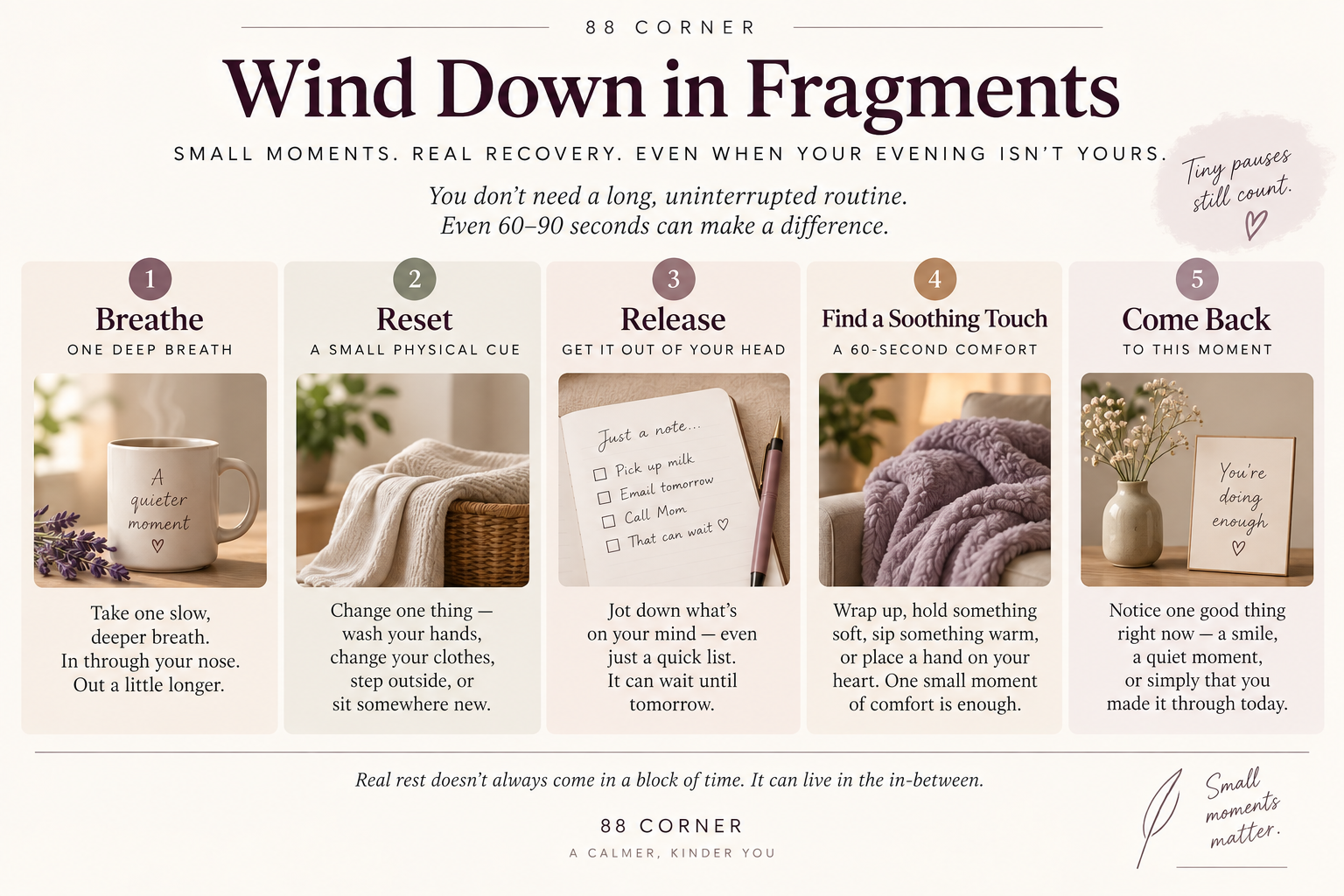
Most wind-down advice assumes your evening ends — that at some point the day is officially over and you get a stretch of time to spend on yourself. If you’re a parent whose kids wake up, someone doing a second shift after your first one, or a caregiver whose evening is really just an extension of the day with different tasks, that block of time may not reliably exist. The problem isn’t that you lack the motivation or even the energy to unwind. It’s that there’s no clear edge to unwind from.
That distinction matters, because most routines — including a genuinely good one — need a start and a finish. A bath, a page of a book, five minutes of stretching: these all assume ten or fifteen uninterrupted minutes. When that window keeps getting swallowed by one more thing, following a sequence can feel like one more task you failed at, on top of everything else.
Why every wind-down routine assumes a block of time you don’t have
Search for evening routines aimed at parents and you’ll find dozens of lists — most of them genuinely well-intentioned — built around “after the kids are in bed.” That’s a reasonable default, but it treats the post-bedtime hour as guaranteed, when for a lot of people it’s the least reliable part of the day: a second wake-up, a load of laundry that has to go in tonight, a message from work that can’t wait. The routine isn’t wrong. It’s just built for an evening that isn’t everyone’s.
Sleep and stress research offers a partial explanation for why this feels worse than simple tiredness: chronic evening stress can keep cortisol — a hormone that’s supposed to taper off at night — elevated longer than it should, leaving you simultaneously exhausted and unable to settle. That’s real, and it’s worth knowing your body isn’t malfunctioning. But it’s a different problem from the one this article is about, which is more mechanical: there’s often no minute-ten to get to, because minute-three got interrupted.
Winding down in fragments, not in sequence
If the evening won’t give you one block, the alternative is to stop treating recovery as something that has to happen in one. A small but genuine body of research on workplace micro-breaks — short pauses of a minute or two during a workday — has found they measurably reduce fatigue and improve well-being, and that even very brief breaks produce real benefit. That research was done on workdays, not evenings with kids or caregiving involved, so it’s not a perfect match — but the underlying principle holds up: recovery doesn’t have to be long to count. It has to actually happen.
What counts as a fragment. Something under two minutes, that doesn’t require anyone else’s cooperation, and that you could do again in ten minutes if you got interrupted. Not a to-do item — a pause with nothing attached to it.
Four places to tuck one in:
- While something else is already running. The 90 seconds the microwave takes, or the dishwasher fills — instead of scrolling, put both hands flat on the counter and just wait.
- A transition you already make. Brushing your teeth, hanging up your coat, walking from the car to the door — pick one that happens most nights and let it be the only thing happening, instead of doing it while planning tomorrow.
- The gap before you pick up your phone. Before you unlock it, take one slow breath out. It doesn’t have to replace the phone — it just has to happen first, once.
- The last minute before you turn off a light. Not a full routine — just a moment where nothing else is asked of you, even if the rest of the room still needs attention.
None of these require the day to be finished. They fit inside a day that isn’t.
What the research actually supports (and what it doesn’t)
It’s worth being precise here: the micro-break research shows short pauses help with fatigue and well-being in a workday context — it does not show that 90 seconds four times a night is equivalent to a real evening off, and this article isn’t claiming that. What it offers is something smaller and more honest: a way to get some recovery on the nights when the alternative is none at all, not a replacement for actual rest when you can get it.
When this is ordinary and when it’s something more
Feeling stretched thin some evenings, especially with young kids or caregiving responsibilities, is common and doesn’t need a diagnosis. Persistent exhaustion that comes with emotional distance from the people you’re caring for, or a sense that nothing you do as a parent or caregiver feels like enough anymore, is different — recognized in psychological research as parental or caregiver burnout, and it deserves real support, not a routine. If that sounds closer to what you’re feeling, a conversation with a doctor or therapist is the right next step, not another list of tips.
A small routine, not a rescue
On a night with an actual free hour, a longer wind-down — like the four-step routine built for zero-energy nights — is worth using. On a night with no hour at all, four small pauses spread through an evening that never really stops are still real recovery, even if they don’t look like rest from the outside. Warmth helps in both cases: a heating pad or a warm eye covering during even one of those brief pauses gives the moment somewhere to land, without asking for time you don’t have.
Related reading
The Wind-Down Routine for Nights You Have Zero Energy — for the nights you do get a stretch of time to yourself.
Self-Care Sunday Ideas (The Small Sunday) — the same energy-matching idea, applied to a full day off.