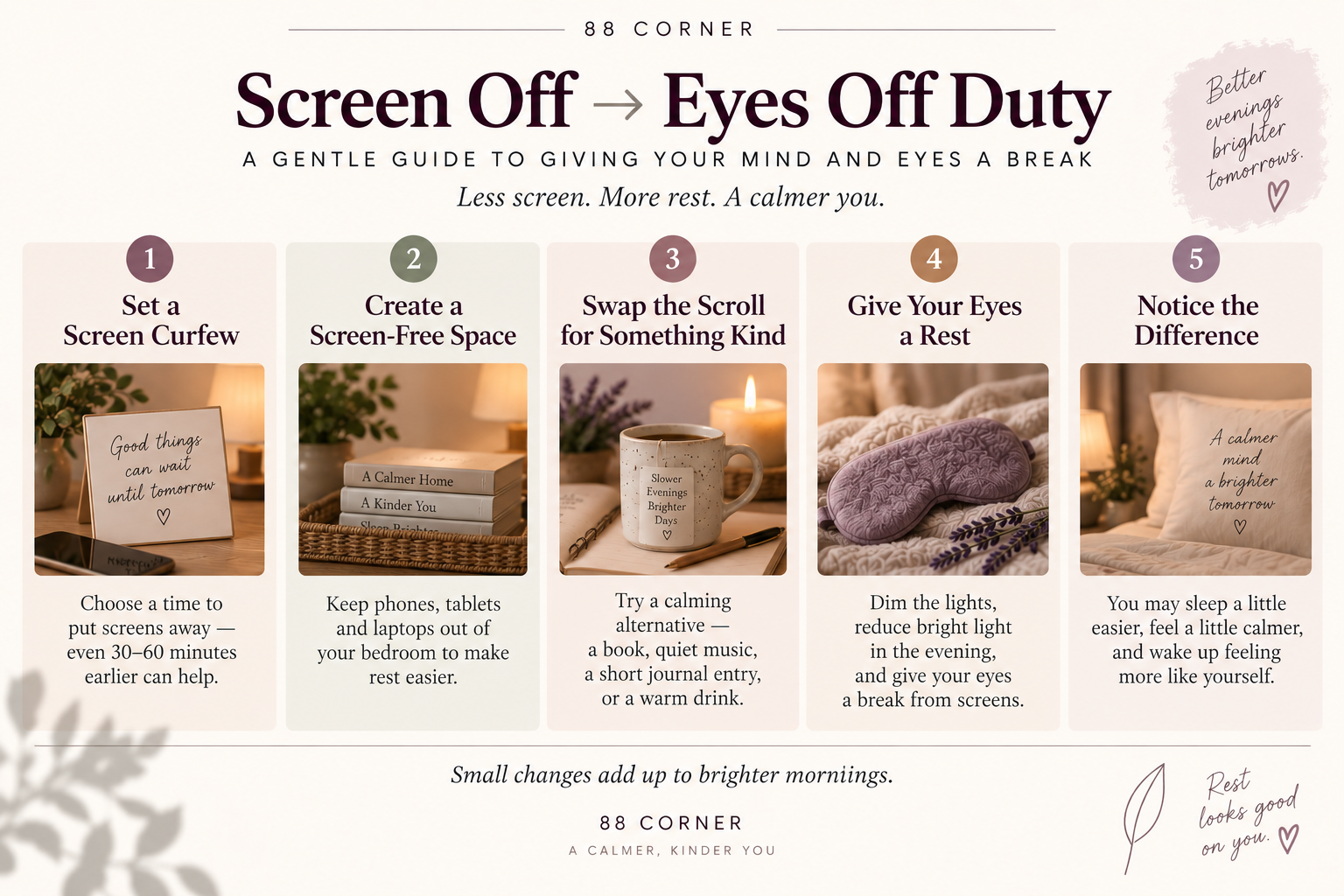
Tired, dry, or achy eyes after a day of screens are almost never about blue light. They’re almost always about three ordinary things: your eyes staying focused at one fixed distance for hours, blinking less often than usual, and screens themselves demanding more visual effort than print due to glare and lower contrast. Knowing which one you’re dealing with changes what’s actually worth doing about it. This is sensory rest, specifically for screen fatigue — one type worth understanding on its own.
What’s actually causing it (and what isn’t)
The American Academy of Ophthalmology and American Optometric Association both describe digital eye strain (computer vision syndrome) as coming from sustained near focus, a documented drop in blink rate during screen work (which dries out the eye’s surface), poor lighting or glare, and posture. None of the leading causes is the color of the light.
About blue light, specifically. This is worth being precise about, because two respected organizations don’t fully agree here. The American Academy of Ophthalmology states plainly that there is no scientific evidence blue light from digital devices damages the retina, doesn’t recommend blue-light-blocking glasses, and points to multiple studies showing those lenses don’t actually reduce digital eye strain symptoms. The American Optometric Association takes a more cautious stance on long-term blue light exposure. Given the AAO is the medical (not just clinical-optical) authority on retinal health specifically, this article follows its position: nothing here supports the popular claim that ordinary screen use is damaging your eyes. Blue light does have one well-documented effect — it can suppress melatonin and affect sleep timing when screens are used close to bedtime — which is a reason to dim screens in the evening, not a reason to fear them during the day.
The 20-20-20 rule — useful, but say this about it honestly
The AOA recommends looking at something 20 feet away for 20 seconds every 20 minutes. It’s a reasonable, low-effort habit. It’s also worth knowing that the rule’s own originator, optometrist Dr. Jeffrey Anshel, has said no peer-reviewed studies have validated it. That doesn’t make it useless — shifting focus and taking a break is sound in principle — it just means it’s a helpful habit, not a proven cure, and it’s fine to stop treating it as more scientifically settled than it is.
A 5-minute screen-to-rest transition
Built around what actually causes strain — not blue light — this is meant for the moment the workday or scrolling ends, not as a cure mid-task.
- Look far away for 20–30 seconds — out a window if you have one, or across the longest distance in the room.
- Blink deliberately, ten slow, full blinks — this rewets the eye’s surface after hours of reduced blinking.
- Dim or remove the screen entirely — put the device somewhere out of sight, not just face-down beside you.
- Close your eyes for a minute in a dark or dim room — full darkness, no scrolling with your eyes closed.
- Add a physical comfort step — a warm covering over closed eyes for a few minutes, mainly for the dryness and the dark, screen-free pause it creates, not as eye-strain treatment.
Where a warm eye covering actually fits
Warm compresses are genuinely well-supported for dry eye and related conditions like blepharitis, where warmth helps the eyelid’s oil glands function better — that’s real, established guidance. Digital eye strain and dry eye overlap (reduced blinking dries the eye’s surface), so a warm compress can reasonably help the dryness piece of screen fatigue. It isn’t a treatment for eye strain as a whole, and nothing here claims that a heating pad, eye mask, or any product treats, cures, or prevents an eye condition. Its honest role is simpler: giving you a dark, warm, screen-free few minutes after the device is actually put away — a good closing step, not a fix on its own.
When to see an eye doctor instead
Occasional strain after a long screen day is ordinary. Persistent pain, blurred vision that doesn’t clear, sudden vision changes, or dryness and discomfort that don’t improve with breaks, blinking, and basic lubricating drops are reasons to see an eye doctor rather than trying another home routine. A fuller evening reset, if screens weren’t the only thing that wore you out today, might be worth trying next.