
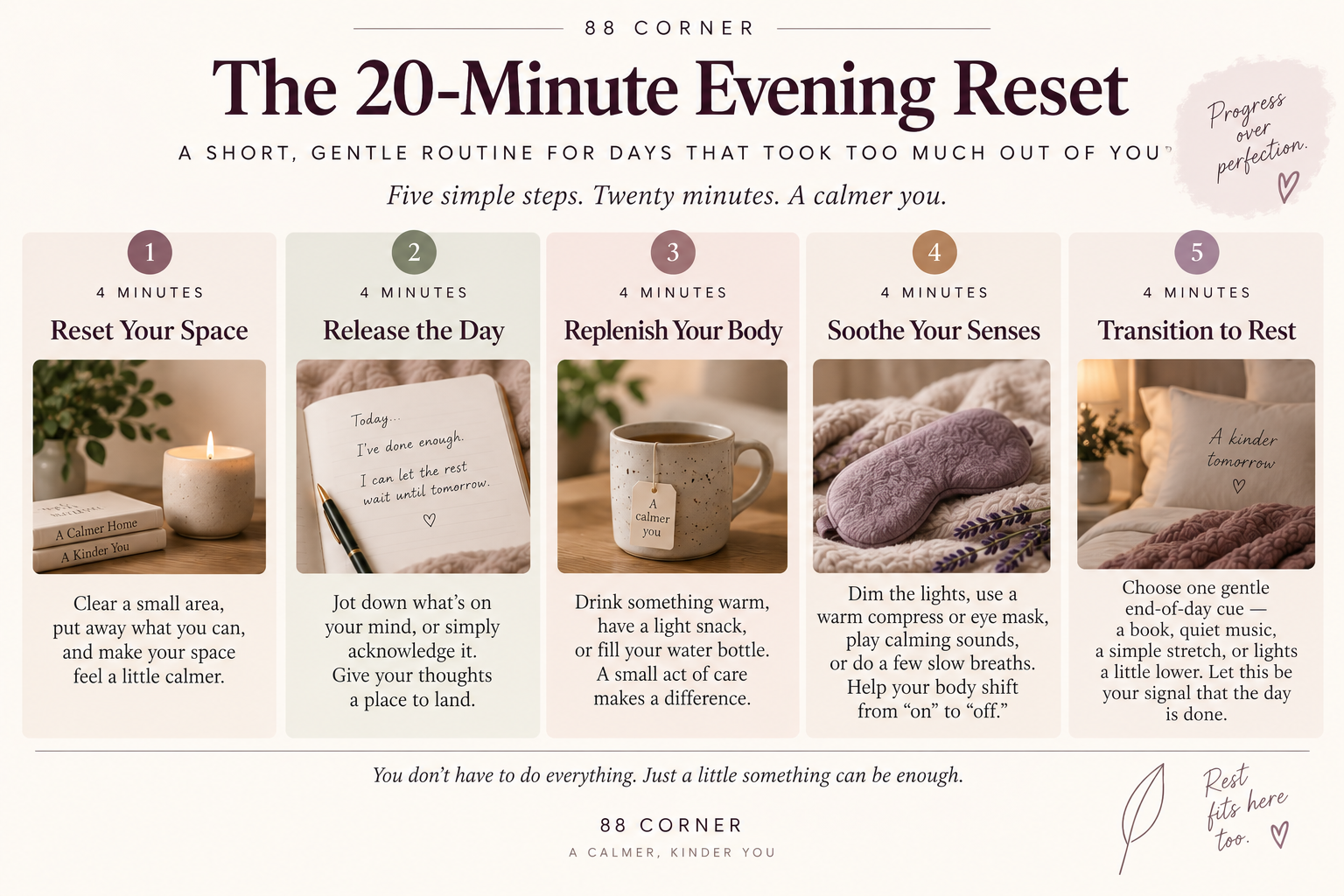
Twenty minutes, three parts, nothing here about tomorrow. This routine is built to come down from a day that took more out of you than usual — not to organize the next one. If you’re looking for a routine that also lays out your clothes and plans tomorrow’s to-do list, most evening-routine content already does that. This one doesn’t, on purpose.
What this routine is (and isn’t)
It’s a sequence, not a menu — you’re not choosing three tips out of fifteen tonight. It’s timed and tested to actually take about 20 minutes, not labeled “20 minutes” without anyone checking. And it ends at “the day is over,” not at “tomorrow is ready.” If you want to prep for tomorrow too, do it earlier in the evening, separately — mixing the two turns a reset into another task list.
The 20 minutes, broken down
Minutes 0–5: Transition
Change out of whatever you’ve been wearing since you got home from wherever your day happened — even if that’s just work-from-home clothes. Put your phone and bag somewhere you won’t see them for the next 15 minutes. This is the one step that has to happen first: your nervous system needs a physical signal that the day has a different phase now, not just a mental note that it should. For readers coming straight from work, a fuller look at the moment work ends and home begins goes deeper on this exact transition.
Minutes 5–15: Comfort
Sit or lie down somewhere comfortable, with no screen and no task. Add warmth if it helps — a heating pad on your shoulders or neck, or a warm compress over your eyes — and let ten minutes pass without producing anything. This is the actual reset; the other two segments exist to protect it. And if it’s not time you’re short on, but a specific kind of rest, that’s worth figuring out too.
Minutes 15–20: Close
Say or write one sentence about the day — what was hard, what helped, or just what happened. That’s it. If there’s genuinely one unavoidable thing for tomorrow (a lunch that has to be made, an alarm that has to be set), do that one thing and stop there. This isn’t the moment for a full tomorrow-prep routine — that’s a different task, for a different part of the evening, done with a clearer head than the one you have right after a hard day.
Why this order, and why nothing here preps for tomorrow
The transition has to come first because nothing about the comfort segment works if your body still thinks it’s mid-task. The close comes last because ending the day cleanly — even in one sentence — matters more than getting a head start on tomorrow, and most existing “resets” quietly turn into productivity routines by folding in planning and prep. Keeping this one decompression-only is the whole point.
If 20 minutes still isn’t there tonight
Some nights don’t have 20 minutes, or don’t have them in one piece. If tonight’s one of those, the comfort segment on its own — even five minutes of it — is worth doing alone. And if the evening itself is the problem, not the routine, How to Wind Down When Your Evening Isn’t Actually Free covers what to do when there’s no real block of time at all.