
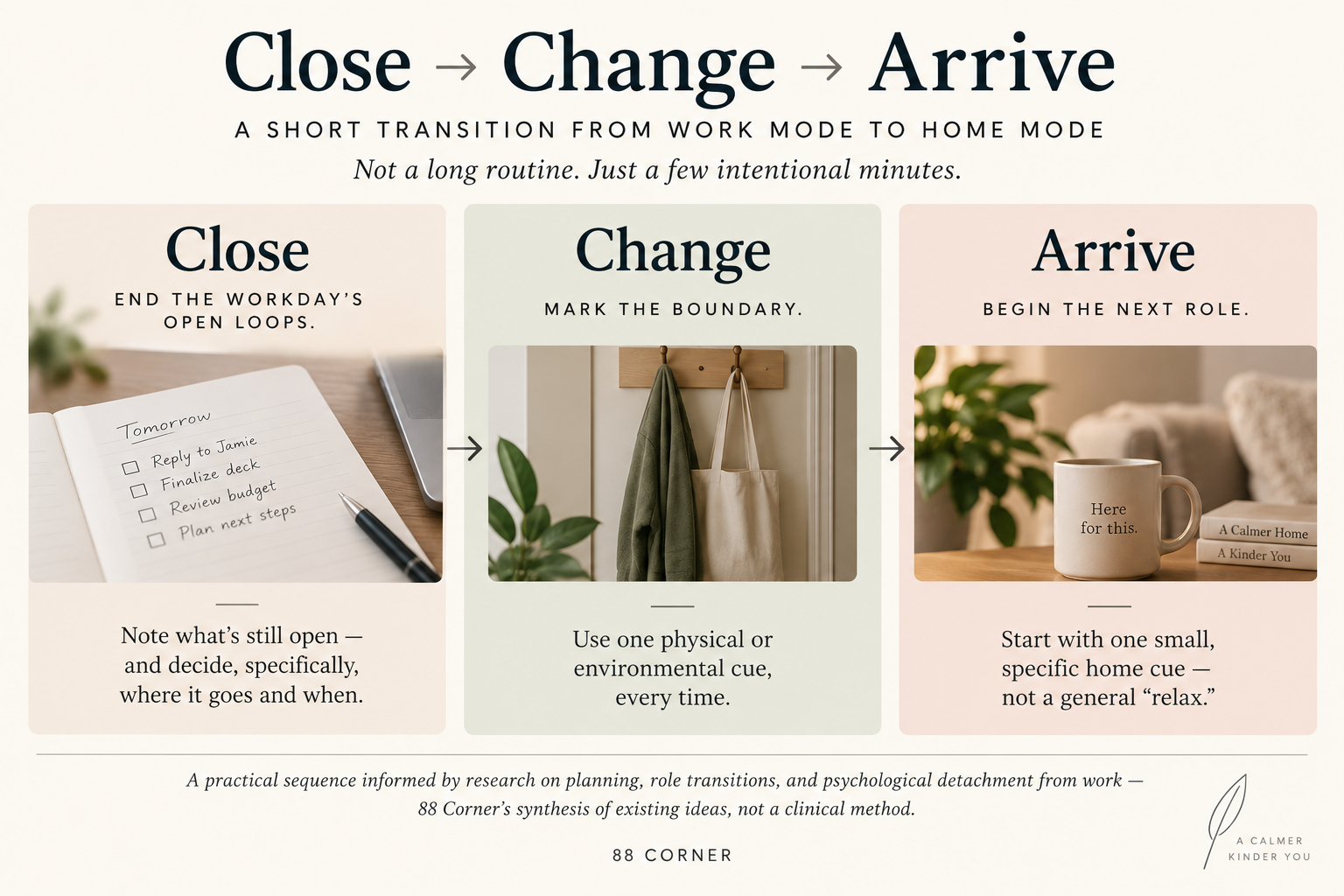
If relaxing activities haven’t been helping you switch off from work, the missing piece may be the transition itself, not the activity. A short sequence works better for a lot of people than another relaxing activity on its own: close the workday’s open loops, change one physical or environmental cue, and begin the next part of your day with one specific action. Close, change, arrive — a few minutes, not a long routine, and it’s worth trying before assuming the problem is that you haven’t found the right way to relax yet. It’s why the same relaxing activity doesn’t always work — the activity was rarely the real problem.
Not everyone needs the same boundary
Some people want a clean line between work and home. Others are comfortable blending the two — checking a message during dinner without it bothering them. Research on work-life boundaries treats this as a continuum of preference and strategy, not a fixed trait, and neither end is inherently better. What tends to matter more is whether the amount of blending feels chosen or intrusive. The goal isn’t a perfect boundary. It’s a boundary that feels chosen — which is worth trying this sequence for even if you’re someone who’s generally fine mixing the two, on the days it doesn’t feel fine.
Close, change, arrive
Close. Before calling the day over, take a couple of minutes to look at what’s still open and decide, specifically, what happens to each thing — not just “I’ll deal with it later,” but where it goes and when. Research on unfinished goals has found that a vague awareness of an open task keeps intruding on your attention, but making a concrete plan for it — even without finishing it — largely stops that intrusion. This is also the idea behind what author Cal Newport calls a “shutdown ritual”: a short, consistent way of reviewing the day’s loose ends and marking, to yourself, that work is closed.
Change. Pick one physical or environmental cue and make it consistent: change out of work clothes, even if you worked from the same room all day; step outside and walk around the block once; or close a door that stayed open during work hours. Organizational research on role transitions (most notably a well-known paper on workplace boundaries) treats this kind of deliberate marker as a reasonable way to help a boundary-crossing register — it’s a theoretical proposition drawn from how people describe managing roles, not a tested intervention with measured outcomes, but it’s a low-cost thing to try and matches how a lot of people already instinctively try to mark the day’s end.
Arrive. This is the step most advice skips. Closing work and changing your physical state isn’t the same as starting your next role — parent, partner, or simply yourself, off the clock. Pick one small, specific action that belongs only to that role: greet whoever’s home before checking your phone again, put on music that has nothing to do with work, or sit somewhere that isn’t your workspace before doing anything else. Research on psychological detachment — genuinely disengaging from work during nonwork time — links it to less exhaustion and better well-being, though this comes from observational studies, not controlled experiments, so it’s an association worth taking seriously rather than a guarantee. A vague instruction to “relax” doesn’t specify a role to step into; “arrive” does.
What about the commute?
A commute used to do some of this work automatically, and there’s early research suggesting it can function as a kind of buffer between roles — but that research is small and preliminary, and it comes with a real catch: a stressful commute doesn’t seem to give the same benefit, so commuting itself isn’t something to romanticize or try to recreate for its own sake. If you lost a commute when work went remote, the point isn’t to miss it — it’s that the sequence above is one way to recreate the boundary-marking part without needing the traffic.
When the problem is bigger than a transition
A short sequence helps with the ordinary version of this problem — work that doesn’t have a clear edge. It isn’t a fix for chronic overwork, an unmanageable workload, or burnout, which involve real structural problems a three-step routine can’t solve. If closing your laptop never actually closes anything because the job itself doesn’t allow it, that’s worth addressing directly — with a manager, a change, or professional support — rather than adding another evening ritual on top of a schedule that doesn’t have room for one. And if what’s waiting on the other side of arrive is a second shift, not a rest, that’s worth naming for what it is too.
The workday needs an ending before the evening gets a beginning. Close, change, arrive is one way to give it one. Once you’ve arrived, a 20-minute reset for days that took too much out of you might be exactly what’s next.