
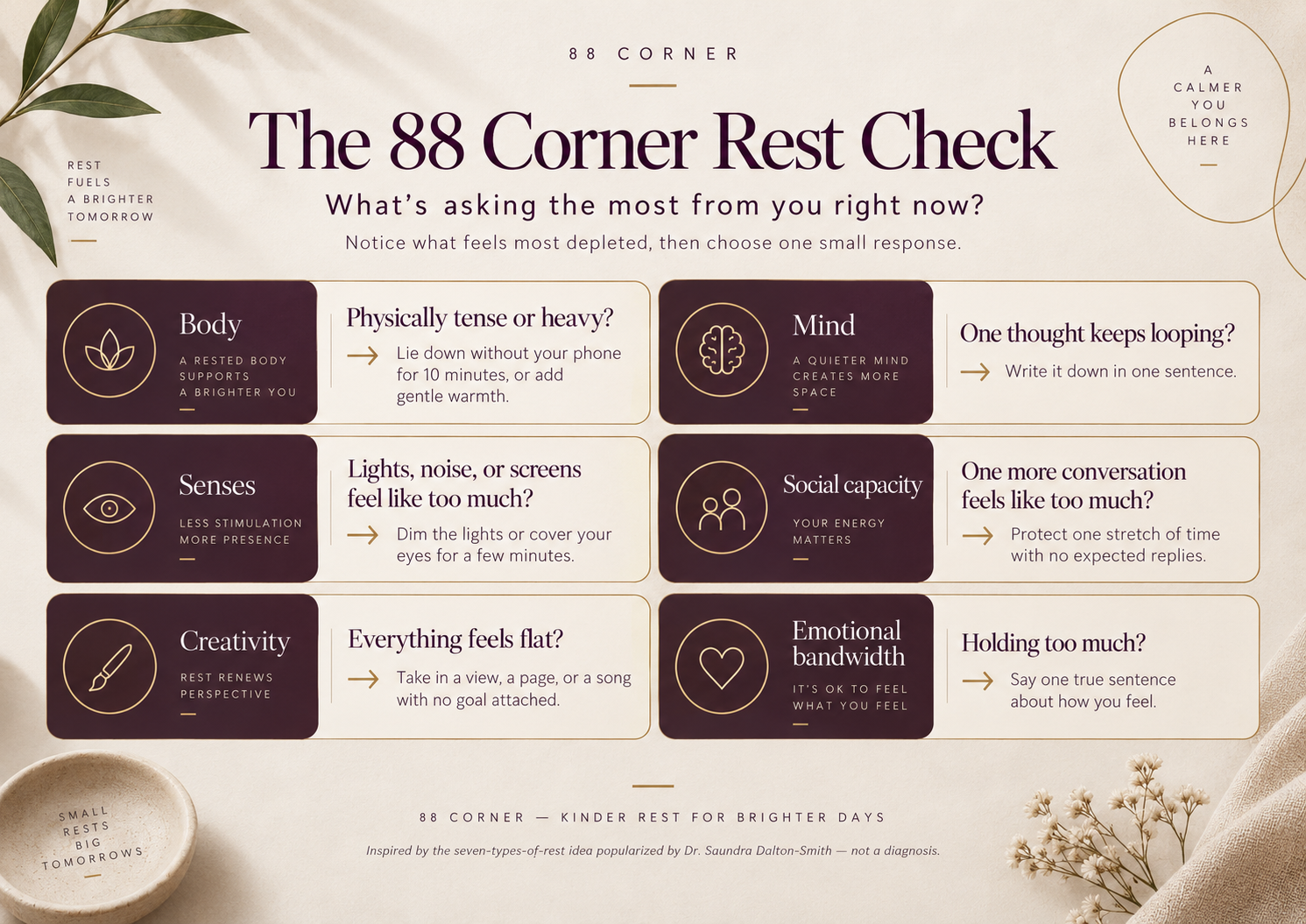
You don’t necessarily need more rest — you need the kind that matches what’s actually depleted. Sleep is essential, but even a full night of it doesn’t automatically resolve every kind of mental, sensory, social, or emotional depletion. That’s the real answer to “what kind of rest do I need”: notice what’s running low right now, and choose something small that actually addresses that, instead of defaulting to sleep or a day off and hoping it covers everything.
Why sleep doesn’t always fix tiredness
If you’re sleeping a reasonable number of hours and still waking up tired, that’s worth taking seriously rather than pushing through. Cleveland Clinic points to several possible reasons unrefreshing sleep happens: sleep disorders like sleep apnea, a sleep environment that’s too bright, noisy, or warm, certain medical conditions (thyroid issues, low iron), and mental health factors like stress or anxiety that keep the brain more alert than it should be overnight. Any of those can mean you’re getting hours of sleep without getting the recovery that’s supposed to come with it — a separate problem from the one this article is mainly about, and worth ruling out first if it sounds familiar.
If you seem to be sleeping well and still feel depleted, more sleep may not be the only kind of recovery you need. Sleep supports physical and mental functioning, but it doesn’t automatically resolve every kind of mental, sensory, social, or emotional strain you may be carrying — rest isn’t one thing, and some of what feels worn down simply isn’t what sleep is built to restore.
Rest isn’t one thing — where the “seven types” idea comes from
This idea has a specific, and honestly worth-naming, origin. Dr. Saundra Dalton-Smith, a board-certified internal medicine physician, described seven types of rest in her book Sacred Rest — physical, mental, sensory, creative, emotional, social, and spiritual — each addressing a different kind of depletion. Harvard Health, which has covered the framework, describes it carefully: it says Dalton-Smith “posited” seven types of rest — a deliberately careful word. This is a physician’s clinical framework, built from her own observation and since developed into a body of work she teaches and consults on, including her own free assessment — not a peer-reviewed taxonomy independently confirmed by controlled research. That’s worth knowing plainly: genuinely useful as a way to think about different kinds of depletion, not a settled medical classification.
In her own words, briefly: physical rest splits into passive (sleep, napping) and active (yoga, stretching, massage) rest for the body. Mental rest addresses a mind that won’t stop cycling — she suggests scheduled breaks through the day and keeping a notepad nearby for racing thoughts. Sensory rest counters overstimulation from screens, bright light, and background noise. Creative rest is for when everything feels flat or used-up, inspiration-wise — addressed by deliberately taking in something that produces genuine awe, in nature or art. Emotional rest is having the space to express your feelings honestly, including stepping back from people-pleasing. Social rest is about telling apart the relationships that genuinely revive you from the ones that quietly exhaust you. And spiritual rest is a sense of connection beyond the day-to-day — belonging, purpose, something larger than your task list.
The 88 Corner Rest Check
Here’s a way to use that idea without turning it into a quiz — Dalton-Smith also offers an official quiz-style assessment designed to identify areas where you may be experiencing a rest deficit. What’s more useful day to day is a quick, repeatable check-in, because what’s asking the most of you on a hard Tuesday isn’t necessarily what’s asking the most after a loud weekend.
Two questions, really: what’s asking the most from you right now — and what’s one small way to give that area less to carry?
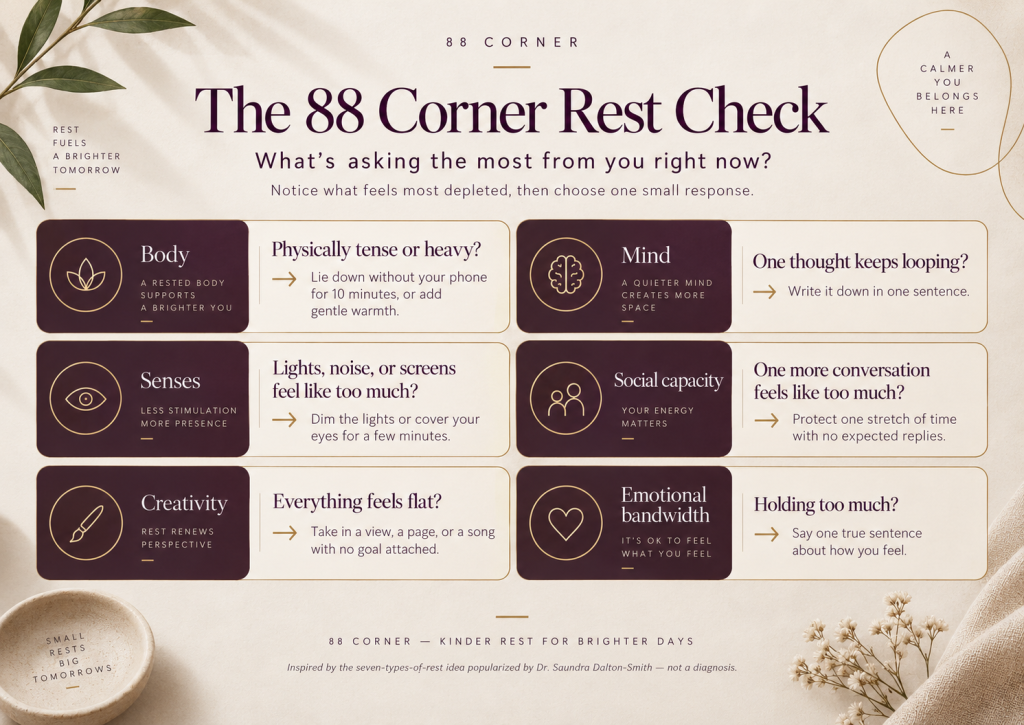
The table below covers six of the domains above (see the note underneath for why spiritual rest isn’t included here). Read through it and notice which one or two feel true right now — you don’t need to address all six at once.
| If this feels true right now | A low-effort option to try |
| Body — physically tense or heavy, regardless of how much you slept | Lie down without your phone for ten minutes, or add gentle warmth to tense areas if that helps you. |
| Mind — attention scattered, or one thought keeps looping | Try writing the looping thought down in one sentence, just to get it out of your head. |
| Senses — lights, noise, or screens feel like more than usual | Consider dimming the lights, covering your eyes, and sitting in near-silence for a few minutes. For sensory rest, specifically for screen fatigue, there’s a fuller routine. |
| Social capacity — even one more conversation feels like too much, even with people you like | One option is protecting a stretch of time with no expected replies — even fifteen minutes. |
| Creativity — everything feels flat, like you’re only ever producing and never taking anything in | You might look at, read, or listen to something with no goal attached — not for a task, just to take it in. |
| Emotional bandwidth — you’ve been holding space for others’ feelings (or your own) with little left over | A simple response could be saying one true sentence, out loud or in writing, about how you actually feel — to no one but yourself. |
This Rest Check draws on six of the domains from Dr. Dalton-Smith’s seven-types framework and is inspired by that broader idea — it isn’t a reproduction of her full model or a diagnostic tool. Spiritual rest, her seventh category, is real and valid; it’s left out here because it’s deeply personal and doesn’t reduce to one universal action the way the others do, and it deserves to be considered on its own terms rather than checked off a list.
When it’s more than ordinary tiredness
This check is for everyday depletion — the kind that responds, at least somewhat, to noticing it and doing something small. If tiredness doesn’t improve despite reasonable rest, stress reduction, and basic self-care for two weeks or more, Mayo Clinic’s guidance is straightforward: that’s a reason to talk to a doctor, not a reason to try harder at a checklist. That’s a normal, sensible boundary — not a cause for alarm, just a signal that something else may be going on that a reflection tool isn’t built to address.
Rest, matched instead of guessed at
Most advice defaults to “get more rest” as if rest were interchangeable. It isn’t. Noticing what’s actually asking the most of you — even in a two-minute check-in — tends to work better than defaulting to sleep or a day off and hoping it covers everything. Some evenings that’s warmth and quiet for a tense body and overloaded senses; other nights it’s fifteen minutes with no one needing anything from you. Either one counts as rest.
Related reading
The same idea, applied to a full day off.
If it’s not any one kind of rest that’s short, but time itself.